Showing posts with label domestic interior. Show all posts

Sunday, 26 February 2012

Leighton House Museum: A 'Palace of Art'

Unexpected gilt and mosaic interior: The Arab Hall
Unassuming red-brick façade: Leighton's House

Executive Summary

Home of C19th artist and socialite Frederic, Lord Leighton, Leighton House is renowned for its breathtaking gilded ‘Arab Hall’, an ‘Oriental’ fantasia that would induce sheer paroxysm in Edward Said. The house is also a shrine to a moment in British cultural history when a new aestheticism was being shaped in painting and design, and the status of the artist was being renegotiated in Victorian society. An evocative environment that fuses neoclassical paintings and Turkish tiles, taxidermied peacocks and William Morris wallpaper, it feels like the country house of an eccentric V&A curator who’s been slowly siphoning off the collection.

Leighton's busy studio, c.1880s
Go There…
… to impress a date or friend with unexpected splendour (the unassuming brick exterior gives nothing away) and to ponder the relics of late Victorian celebrity, which is infinitely more interesting than present incarnations.

Must-Know Info
Address: 12 Holland Park Road, London, W14 8LZ (closest tube: High Street Kensington)
Telephone:  020 7602 3316 Admission: £5 adult; £3 concessions
Opening Hours: Daily (except Tuesday): 10am -5.30pm; Guided tours on Wednesday at 3pm

Portrait of Leighton in Vanity Fair, 1872
Background
Frederic, Lord Leighton came from a well-off family who moved around the Continent throughout his childhood, exposing him to a rich variety of cultural influences which he complemented with studies in Florence followed by a few years in Paris, mingling with the likes of Ingres, Corot, Millet and Delacroix. A dedicated artist by the age of 15, by his mid-thirties Leighton was earning a generous income in England from his increasingly popular neoclassical history paintings (Queen Victoria bought one of his works when he was only 25). In a shrewd career move, Leighton created a home that would double as his calling-card – and befit the status of president of the Royal Academy – showcasing not only his own art, but an expansive collection of other artists’ works (Burne-Jones, Watts, Sargeant, Millais). It also embodied his eclectic interior aesthetic, and middle class individuals (for whom taste in interiors was at a significant point of malleability) as well as the working class could, at various points, tour the house or admire lavish images of it in the Victorian equivalent of Garden and Home.

Red flocked wallpaper in the dining room
Built incrementally between 1866 and 1895 – when the final addition of a top-lit picture gallery was completed – Leighton House was designed simultaneously as studio, spectacle and home (though the former two elements predominate). Art and sociality are clearly intended to mingle: his light-drenched first floor studio, for example, also sports a minstrels’ gallery, once bestrode by clients (for a better view of monumental work), guests, and the musicians who dazzled at Leighton’s A-list soirees.

Masharabiya latticework window from Egypt
Drawing of the Masharabiya, C19th
Curation, Restoration & Interpretation
After years of benign neglect and a multitude of incarnations – including being used as a children’s library, with the Arab hall’s sparkling dome disguised under layers of lining paper and emulsion – a recent £1.6 refurbishment presented the opportunity for the house to be restored to its former glory.  Leighton’s furniture and collection were auctioned off after his death: some items have found their way back, some replicas (such as a copy of Corot’s series Four Seasons) have been commissioned by artists and craftspeople still using the same technique as 150 years ago, and other period furniture has been brought in to recreate the spirit and appearance of the house as closely as possible. The veritable archive of black-and-white images (prints, drawings and photographs) of the house and collection in its heyday (for its interiors were as much the subject of discussion as its influential owner) gave curators and conservators a lot of material to work with. Meanwhile original samples found beneath utilitarian overpaints, allied to contemporary descriptions of the house’s curious hues, helped restore it to its splendid original colours: the sage green walls of the drawing room or the Pompeian red flocked wallpaper and scarlet floorboards of the dining room, where Leighton curiously ensured that his seat was always a little higher than those of his esteemed dinner guests.  The result is a resounding success, the only detraction the starkness of the garden that seems at odds with the house – though that may just be a consequence of visiting in February!

Spartan bedroom and simple single bed
There are various ways to engage with the house, the artist and his collection: Ipod tours available on the museum's website, guided visits, and lavishly produced information cards in each room. These offer informative but not invasive interpretative material, and it is equally possible to just wander from room to room, conjuring up a personal mental image of Leighton from a composite of visual delights. Even without the knowledge that Leighton burnt his private papers, never married and, although immensely popular, appeared to have only a few close and sustained friendships (his dying words, apparently, were ‘give my love to the Academy’), the ratio of lavish social/public to personal/private space – a single, rather Spartan bedroom that is hardly distinguishable from the butler’s bedroom in the basement, and, tellingly, no guest room – offsets the general opulence with a note of vulnerability.

Peacock blue!
Death of Brunelleschi, 1852
Best in Show
I could have lounged in the sun-drenched studio for hours, and it’s important to set this room at the centre of one’s visit, as it is from Leighton’s identity and practice as an artist that everything else flows. While much of his collection of objects and artworks are absent, the studio still has an industrious, slightly charged aura to it (as if a model, sheet loosely draped around bare shoulders, is just preparing to step inside), with maquettes, plaster casts, and sketches clustered on a window ledge, art lining the walls, and some of Leighton’s works poised on easels in the corner. I found the tender portraits of family members - his father and younger sister Augusta - worked into his youthful work Death of Brunelleschi (1852) touching, and having spent a lot of time in Florence, it's hard not to feel partial to the man who solved the greatest architectural quandary of the age. Don't miss the the taxidermied peacocks in the entrance hall: not only do they add to the exotic frisson of the ground floor interior (the Arab hall glints suggestively to your left as you enter), they also pick up the exact turquoise (I think it's actually called 'peacock blue') of the William de Morgan tiles that line the surrounding walls.

 Study of Dorothy Dene, 1884
 Anecdotal Aside
In later life, Leighton’s favourite model and muse was a poor young woman named Ada Alice Pullen, left to raise three younger siblings when her mother died. Pullen rechristened herself Dorothy Dene, a name which she felt better befit a star of the stage, a calling to which she aspired. Leighton provided much of her financial support, and also engaged the services of an elocution expert to attend to her ‘singularly unpleasant Cockney twang’, which he believed was an obstacle to her acting career. She would go on to appear on the London stage for a decade in second leads and supporting roles (though the limelight unfortunately eluded her) in works by Shakespeare and Oscar Wilde. Anyway, the story goes that the playwright George Bernard Shaw, who knew them both, used them as the models for Professor Higgins and Eliza Doolittle in Pygmalion (1912), and its later musical adaptation My Fair Lady (1956). Whether or not the story is true, some of Leighton’s most memorable paintings are those modelled by Dene...

Sunday, 12 February 2012

A 'Middling' Experience: The Geffrye Museum of the Home

Twilight at the Geffrye Museum of the Home
Porcelain tea set, Jingdezhen, China, c.1750-1780
Executive Summary 
 From teacups to textiles, pets to petit-fours (actually, I didn’t notice any mention of pets… perhaps I should bring this absence to the Museum’s attention), the Geffrye Museum offers a glimpse through the keyhole of middle class English domestic interiors from the seventeenth to the twentieth centuries.

A hall in 1630
Go There If...
...You’re looking for retro décor inspiration, or a meander through time that offers a genteel afternoon tea en route. Don’t go there if the niggling insistence on calling the middle class ‘the middling sort’ (in order to avoid anachronism: the term ‘middle class’ only came into common use in the C19th ) gets on your nerves.

Must-Know Info:
Address: Kingsland Road,  London,  E2 8EA  (closest tube: Old Street)
Telephone: 020 7739 9893 Admission: Free
Opening Hours: Tuesday-Saturday 10am-5pm, Sunday and bank holidays 12am – 5pm, Closed Mondays

Background
Housed in the former C18th almshouses of poor Shoreditch ironmongers, the Geffrye Museum opened in 1914, after the local council was persuaded by leading members of the Arts and Crafts movement to turn the buildings into a museum linked to the local furniture industry. The aim was to enlighten and inspire the local workforce with exempla of excellent artistic and technical value. Over time, the collection and mandate were widened to represent English domestic interiors more generally, and in 1991 the museum became an independent charitable trust, leading to new developments and displays.

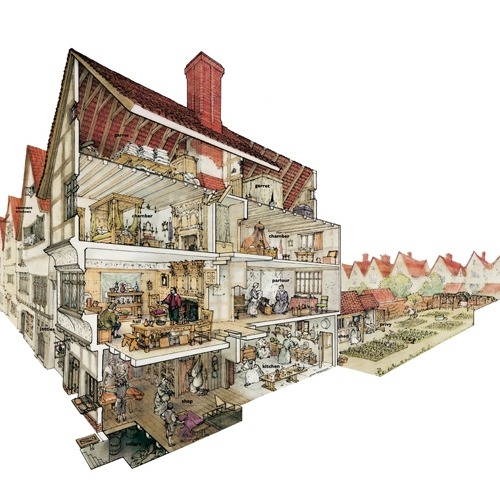
Cutaway drawing representing a merchant's house, c1640
Curation & Interpretation
The Geffrye Museum has a very clear and coherent interpretative strategy: each period of domestic interior featured in the museum offers a wall panel with an overview (cunningly signalled to audiences with the large title: OVERVIEW), including a contextualising timeline and cutaway house drawing. Acting like hyperlinks from the main overview, you’ll find immaculately exhibited objects in glass display cases, audio stations for listening to extracts from related documents of the period (etiquette books, novels, etc), and replica items or material samples for you to touch (hoorah!) The imposing interpretative framework may suit visitors who want highly structured viewing experiences, but it tends to overshadow the possibility for eccentric and serendipitous encounters with objects. 

'Life in the Living Room', 1600-2000...
One of the benefits of the ‘overview’ room, however, is that by offering in-depth information, it forecloses the need for copious explanatory material that could distract from the reconstructed interior that follows. These reconstructed interiors are all ‘living rooms’ (parlours, drawing rooms etc) enabling the viewer to explore change and continuity across a single domain, though after a while you yearn for a C17th privy, a C20th suburban garage! The rooms offer two modes of interpretation side-by-side on a little stand: the descriptive (information about style, furnishings etc) and the anecdotal ('It is mid-afternoon, and the female members of the family have gathered in the drawing room. Mother catches up on matters of fashion and literature by reading her monthly magazine.’). And yet for all these 'living rooms', there is a tangible absence of life...
The Museum's paintings capture a sense of home better than its reconstructions

Highs & Lows
The curious thing for a Museum of the Home, is that it doesn’t feel homely at all. The reconstructed interiors - while admittedly beautiful and pristine - feel oddly sterile, bereft of the life, laughter and conversation of living, breathing inhabitants: a house, but not a home. Occasionally, a glass of milk or a tiny plate of dainties on a table hint in this direction, but they manage to look entirely calcified, rather than suggesting the imminent return of an inhabitant to reclaim their snack.  I realise that when you’re dealing with priceless original furniture and ornaments, you can’t invite visitors to lounge in the parlour with their feet on the table, and I'm not suggesting something tacky like wax models, but I’m convinced that one could subtly evoke a sense of lived presence nonetheless. Perhaps this could be achieved by using the odd sound installation - snippets of conversation, strains of music - or moderated light settings (they have appropriate lighting objects for each era, but these are merely on display) to create mood and convey how these affected the visual perception and mood of space and surfaces: the play of candelight on porcelain, a flickering gas lamp, or the more uniform illumination offered by electric light (currently the default mode for the whole museum). Adding an extra, sensory dimension to the display would give it that inexplicable, affective element that goes into making a house a home. 

Ugly, but comfy-looking velvet sofa, c.1928
More positively, the building in which the museum is housed is amazing and there is a great cafe and contemporary exhibition/education wing (when it's not the depths of winter, the garden is apparently rather wonderful too). I also really liked that there were spaces set aside for visitors to browse the library of related books, pull up a chair and read further if anything piqued their interest. There are diverse talks organised for adults (I was primarily at the museum for a lecture on Domesticity and Homosexuality in the Postwar Home, an event that is part of a festival tracing untold LGBT histories in London Museums) and great craft activities and online learning resources for kids. The Museum’s website is incredible, with a high quality interface for exploring the collection digitally.

The drawing room of an 'artistic' young couple, 1890
Best in Show
Don’t miss the etiquette and household management manuals – such as Mrs Beeton’s – scattered throughout the museum. And, in the more recent rooms, you can also trace changes in self-presentation by spotting the reading material (novels, magazines etc) carefully positioned to look ‘casual’.  My favourite period room was the 1890s drawing room of an ‘artistic’ couple (I don’t know why but it feels like the scare quotes hide a more nefarious reality), who have rejected mainstream taste for a heightened sensitivity to beauty in art and design. According to the informational panel: 
The ‘artistic’ young couple who live in this house have had a busy day visiting galleries and curiosity shops, and have purchased a piece of pottery from Liberty’s on Regent Street. It will be displayed on the overmantel above the fire. They are about to dress for dinner, and will then spend the evening at the theatre attending a production of Gilbert and Sullivan’s opera 'The Mikado'. Ah, a couple after my own heart.
Loft-style apartment, c1998

Parting Shots
All in all, a somewhat 'middling' (defn: average, unremarkable, not at either extreme) experience, though unmissable if you're into interiors. Also would have expected a wider range of eccentric designer goodies in the gift shop...